

Remembering, Resisting, and Belonging
Chin National Day in Indianapolis

By Dr. David C. Chao, Director of the Center for Asian American Christianity.
A field report on Christian memory, democratic aspiration, and diaspora formation in the Burma Christian community. Read Dr. Chao community portrait of the Burma Christian Diaspora here.
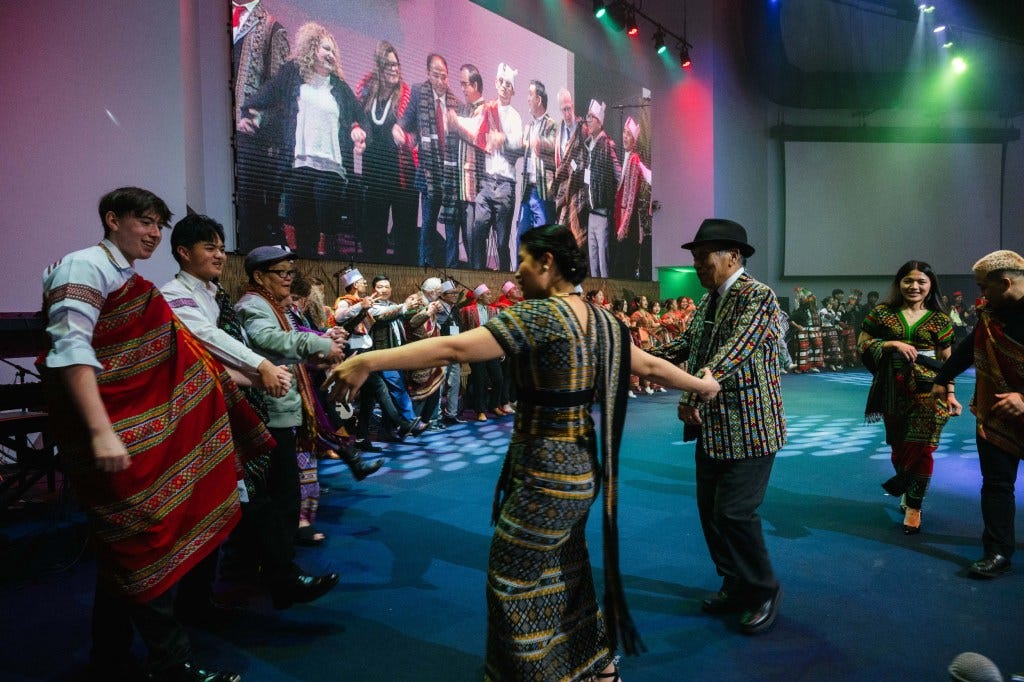
In February 2026, I attended the 78th Chin National Day celebration in Indianapolis. The gathering brought together members of the Chin community, clergy, civic leaders, public health officials, youth performers, families, and invited speakers. Over several hours, the program wove together prayer, historical narration, political testimony, civic engagement, and cultural performance. The result was a layered enactment of memory, theology, and diasporic identity.
For many Asian American Christian readers, the Chin Christian community in Indianapolis may be less familiar than other Asian American immigrant and refugee communities. Precisely for that reason, the celebration deserves careful attention. It offered a window into a Burma Christian diaspora in which national memory, church life, refugee resettlement, public health, and democratic longing remain deeply intertwined. The event also challenged accounts of Asian American Christianity that treat Asian American identity as a stable or singular category. Here, the categories of Chin, Burmese, Christian, refugee, immigrant, citizen, and American came into view together, each carrying its own history and its own moral weight.
This essay offers one situated field report from one public celebration. Its aim is modest: to name the theological and political imagination I observed at this gathering and to consider what the broader Asian American Christian community might learn from it.
Memory, Persecution, and the Work of Peoplehood
The gathering opened with a solemn call to remembrance. The audience was exhorted: “As we honor our heritage and our culture, let us not forget our brothers who continue to endure persecution and sacrifice in the fight for freedom and human dignity.” The statement was then repeated in one of the Chin languages, and the assembly rose together in observance. From the beginning, the tone was reverent and morally charged. Chin National Day was presented as an act of collective memory tied to ongoing suffering, political aspiration, and communal responsibility.
The formal 78th Chin National Day statement, read on behalf of the Chin Community of Indiana, commemorated the February 20, 1948 gathering in Falam. That gathering is remembered as the moment when hereditary chieftainship was abolished and democracy was established as rule by the people. The statement also recalled the Chin decision to join the Burma Union in 1947 and the subsequent experience of military rule beginning in 1962. In this telling, Chin National Day is more than an anniversary. It is a yearly rehearsal of a political memory in which self-determination, dignity, and democratic participation stand at the center of Chin peoplehood.
The statement moved from historical memory to contemporary struggle and then toward future hope. It named displacement, conflict, and human rights violations while affirming unity, dignity, and the intergenerational transmission of language, culture, and faith. Its repeated affirmation, “Together, we remember. Together, we resist injustice. Together, we build hope,” gathered the emotional and moral force of the day. Remembering was presented as a disciplined act of communal formation. It carried the past into the present and instructed the next generation in the obligations of belonging.
Chin National Day is more than an anniversary. It is a yearly rehearsal of a political memory in which self-determination, dignity, and democratic participation stand at the center of Chin peoplehood.
At the celebration, Chin identity was articulated as national, diasporic, and moral. The event enacted peoplehood in exile. It allowed participants to remember Burma, inhabit Indianapolis, honor ancestors, lament present violence, and imagine a democratic future within one communal space.
Theological Interpretation and Political Struggle
The address by Pu Zo Tum Hmung, president and CEO of the Burma Research Institute, clarified the historical significance of February 20, 1948. He underscored that the anniversary marks the abolition of hereditary chieftainship and the establishment of democracy. He also insisted that the anniversary be counted by year, with the number of public celebrations treated as a separate matter. That clarification may seem technical, yet it revealed the importance of historical precision. The year matters because continuity matters. The Chin people were being asked to remember themselves across interruption, displacement, and political violence.
His remarks then moved into an explicitly theological register. Citing a Chin Christian theologian, he identified Min Aung Hlaing as “Satan.” The phrase was stark, and it should be heard within the moral world of the speech. The struggle of the Chin people was framed as a struggle involving democracy, federalism, religious freedom, and resistance to evil. Christians, he suggested, could no longer simply endure the treatment they had received. In his account, political violence had to be named theologically because it threatened human dignity, religious freedom, and the life of the people.
For a broader Asian American Christian audience, this theological framing may sound unfamiliar or even jarring. Many Asian American Christian communities in the United States have learned to speak of politics through the language of civic responsibility, immigrant incorporation, or racial justice. The Chin Christian rhetoric I heard in Indianapolis drew from another register as well: persecution, spiritual warfare, and the moral naming of evil. The point is to recognize that Christian political imagination is shaped by the histories communities carry. For communities formed by military violence, displacement, and religious vulnerability, democracy can carry theological meaning.
The same address concluded with an exhortation to vote in the upcoming United States election. The speaker did not endorse a political party. He invoked John F. Kennedy’s description of the United States as a “nation of immigrants” and emphasized that naturalized citizens share equal responsibility in civic life, regardless of when they became citizens. In that moment, several identities converged: Chin Christian, persecuted minority, diasporic subject, and responsible American citizen. The theological and the civic were braided together.
Civic Integration and the Vulnerability of Refugee Support
One of the most striking features of the celebration was the presence of local public health leadership. Dr. Virginia Caine, representing the Marion County Public Health Department, situated the Chin community within the broader refugee landscape of Indianapolis and the United States. Her remarks made clear that Chin National Day functions as a public forum as well as a cultural and religious gathering. Local government, refugee health, federal policy, and community celebration occupied the same stage.
Dr. Caine described significant federal workforce reductions and noted that overseas assistance teams had been drastically reduced. She also reported a decline in refugee arrivals, from more than one thousand annually in earlier years to far fewer in recent years, and stated that the refugee program had been halted as of January 2025. These details mattered because they named the fragility of the systems that shape refugee life after resettlement. For a community whose story includes displacement and migration, changes in federal refugee policy affect family reunification, health screenings, social services, and the conditions under which new arrivals begin life in the United States.
Her presentation also included health data relevant to the Burmese refugee population, including hepatitis infections, latent tuberculosis, elevated lead exposure among children, and maternal health indicators. She highlighted comparatively strong breastfeeding rates and low smoking rates among Burmese mothers while urging earlier entry into prenatal care. She also noted that annual refugee health funding had been reduced from approximately $1.5 million to $260,000.
These remarks placed public health within a moral horizon. Dr. Caine closed by emphasizing equal economic, political, and social rights. The language of rights, health, and equity resonated with the broader themes of the day. The celebration was embedded in municipal systems and federal policy realities. It revealed how diaspora communities often depend on fragile public infrastructures even as they build dense networks of church, family, and community support.
Cultural Performance and Embodied Memory
Cultural performance occupied a prominent place in the program. Youth and adults participated in traditional dances and a fashion show featuring cultural attire. These performances did more than decorate the event. They taught through bodies, fabrics, rhythms, gestures, and spatial arrangements. They made memory visible.
The clothing and choreography communicated patterns of social life that exceeded spoken statements. Men and women wore distinct garments, and several dances staged patterned interactions between male and female performers. In some paired dances, especially those incorporating bird imagery, the choreography evoked stylized courtship. Male dancers circled female dancers in movements that suggested approach, response, restraint, and mutual recognition within a communal frame.
Youth and adults participated in traditional dances and a fashion show featuring cultural attire. These performances did more than decorate the event. They taught through bodies, fabrics, rhythms, gestures, and spatial arrangements. They made memory visible.
Such observations require care. A visitor’s interpretation of cultural performance remains partial, and participants may understand the same movements through inherited aesthetic, regional, familial, or church-based meanings that are less visible to an outside observer. Even with that caution, the performances appeared to function as embodied pedagogy. They introduced younger participants to a visual and kinetic grammar of Chin identity. They also offered socially sanctioned forms of gendered interaction within a public communal setting.
One particularly striking moment occurred during the fashion show when a male model carried a rifle. A single image is too limited to stand for an entire community, yet the gesture was difficult to ignore. It fused aesthetic display with symbols of armed struggle and visually connected cultural pride to memories of violence and resistance. In that moment, national remembrance, bodily performance, and the realities of conflict seemed to converge.
For Asian American Christian communities, this kind of embodied memory deserves attention. Much of Asian American Christian discourse focuses on sermons, testimonies, institutional histories, and theological statements. Chin National Day reminded me that communities also transmit theology and political memory through dance, dress, posture, and ceremony. The body remembers what prose alone cannot carry.
Internal Differentiation and Generational Formation
The celebration publicly enacted Chin unity, and that unity was powerful. At the same time, the event also suggested the internal complexity of the category “Chin.” Hakha- and Falam-associated identities seemed especially visible, while other groups commonly identified within the broader Chin umbrella, including Zophei, Tedim Chin, and Matu, appeared less visible in the public program. This observation requires qualification. It may reflect the demographic composition of Indianapolis, the particular organizing networks behind the event, the structure of the program, or the limits of my own vantage point. Even so, the observation complicates any assumption that “Chin” is a sociologically uniform category.
This complexity matters for Asian American Christian analysis. We often move too quickly from national or pan-ethnic labels to theological interpretation. Terms such as “Burmese,” “Chin,” and “Asian American” can be necessary and meaningful, yet they can also obscure internal differences of language, region, tribe, denomination, migration history, and local power. Public scholarship on Asian American Christianity must hold together the reality of collective identity and the specificity of internal differentiation.
Chin National Day reminded me that communities also transmit theology and political memory through dance, dress, posture, and ceremony. The body remembers what prose alone cannot carry.
Youth participation also revealed layered patterns of generational formation. Children and teenagers danced, modeled cultural clothing, and occupied public roles in the celebration. Their presence signaled meaningful intergenerational investment. At the same time, conversations with Chin fellows suggested that youth engagement exists along a spectrum. Some young people receive cultural training through churches. Others pursue cultural participation intentionally. Others do not prioritize Chin National Day in the same way as their elders or peers. The public performance of continuity therefore coexists with diverse forms of attachment.
This is a familiar dynamic across many Asian American Christian communities. Elders often seek to preserve language, memory, and communal obligation, while younger generations negotiate belonging through school, church, work, digital culture, and American civic life. In the Chin case, this negotiation is intensified by histories of persecution, refugee resettlement, and transnational political struggle. The question is how younger generations will inherit a people’s suffering, faith, and democratic aspiration in ways that sustain them.
What the Wider Asian American Church Can Learn
The 78th Chin National Day celebration in Indianapolis offers several lessons for the broader Asian American Christian community. First, it reminds us that Asian American Christianity includes refugee histories that exceed the language of immigration, assimilation, or professional mobility. The Chin Christian diaspora carries memories of military rule, displacement, religious vulnerability, and democratic longing. These histories shape worship, public speech, civic participation, and family life.
Second, the event shows that political memory can be theological memory. The abolition of hereditary chieftainship in 1948 was remembered as the birth of people-rule, and that political history was narrated through moral and Christian categories. Democracy was presented as more than a governmental procedure. It was associated with dignity, freedom, and the responsibility of a people before God and one another.
Third, the celebration demonstrated that diaspora responsibility is both transnational and local. Speakers remembered suffering in Burma, invoked democratic struggle, encouraged voting in the United States, and engaged the public health realities of Indianapolis. The community’s political imagination moved between Chin State, Burma, Indianapolis, and the United States. This movement is a defining feature of diasporic citizenship.
Finally, the event invites Asian American Christians to attend more carefully to communities that have often remained peripheral in Asian American theological discourse. Chin Christians in Indianapolis belong within the center of Asian American Christian reflection because they reveal dimensions of it that many dominant narratives have missed: the centrality of refugee resettlement, the weight of persecution, the moral force of national memory, the role of local public institutions, and the labor of passing on culture under conditions of displacement.
Conclusion
The 78th Chin National Day celebration in Indianapolis was a public enactment of nationhood in diaspora. It gathered prayer, historical memory, theological interpretation, civic responsibility, public health advocacy, and embodied cultural performance within a single communal space. The event showed how one Chin Christian community narrates its past, interprets its suffering, and articulates democratic aspiration while inhabiting American civic life.
For the broader Asian American Christian community, the celebration offers a needed reminder. Asian American Christianity is many stories: overlapping histories, languages, migrations, wounds, hopes, and theological imaginations. The Chin community in Indianapolis helps us see that field more clearly. Their remembrance is a form of resistance. Their cultural performance is a form of pedagogy. Their civic participation is a form of belonging. Their hope is carried across generations, across borders, and across the fragile spaces where faith and freedom meet.

Dr. David C. Chao is director of the Center for Asian American Christianity at Princeton Theological Seminary. He teaches courses related to Asian American theology and organizes programs in Asian American theology and ministry. His research and writing focus on the faith and practice of ordinary Asian Christians in diasporic context as well as the uses of Christian doctrine for liberation, the convergence and divergence of Protestant and Catholic dogmatics, and the theology of Karl Barth. His research on Asian American religious life and politics is funded by The Henry Luce Foundation, the Louisville Institute, and APARRI.
Read more about the director of the CAAC here.